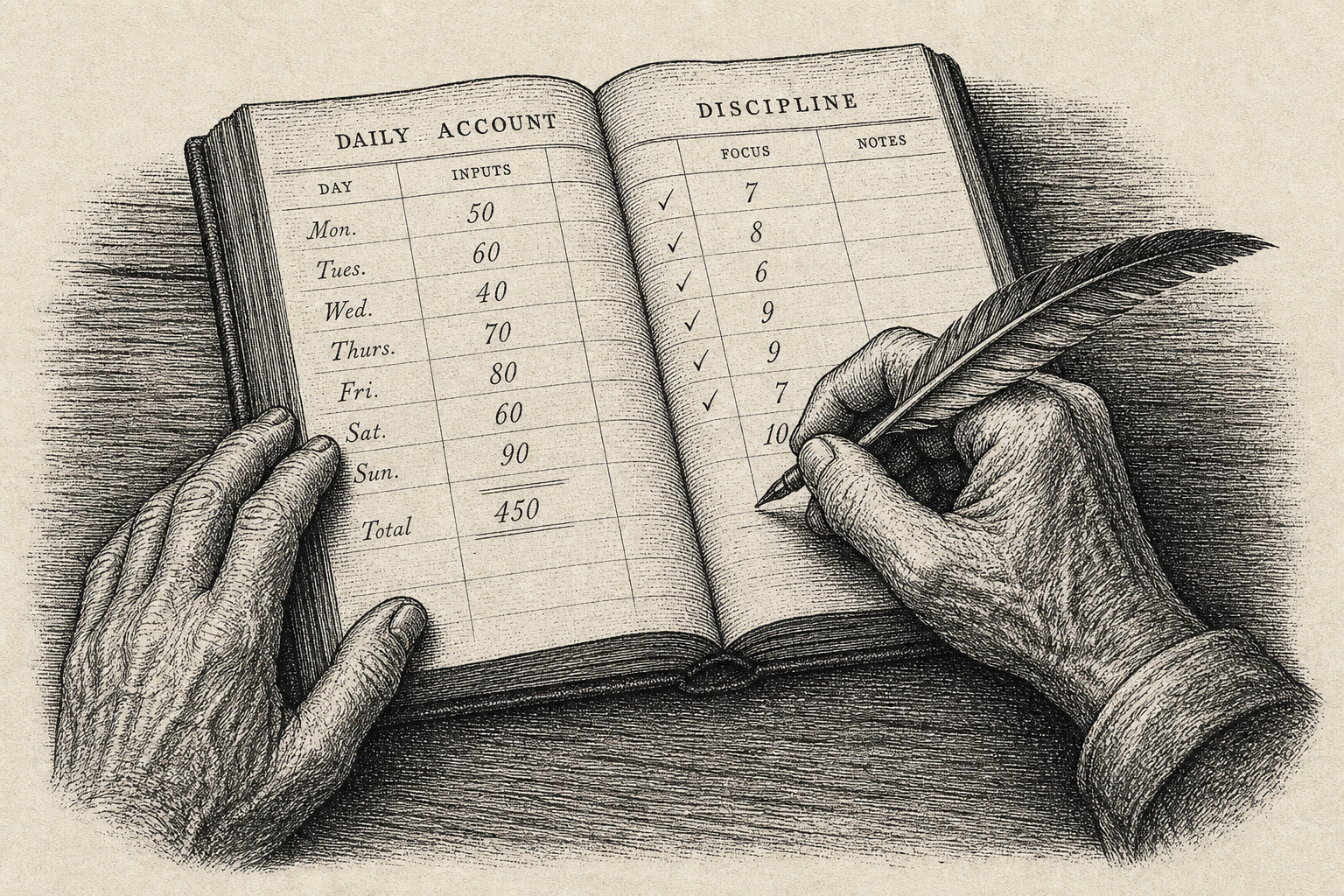
I tracked every input for 30 days — here's the spreadsheet
Posts, replies, DMs. Not vibes.
If you have to force yourself to be consistent, you will lose — because you're fighting your identity instead of changing it.
That's what most creators get wrong about discipline. They hear "post every day" and picture a montage of suffering. Grind. Hustle. David Goggins with a content calendar. They think discipline means lashing yourself to a schedule you hate.
I tried that. Month 1–2: $0 while I negotiated with myself every morning. Motivation weather. Post when inspired. Disappear when empty. Apology thread. Repeat.
You are already disciplined toward the exact goals your environment conditioned — scrolling, consuming, perfecting drafts, avoiding the compose box.
Clarity vs force
→ Unclear goals → daily negotiation → motivation as weather
→ Clear goals → calendar as climate → behavior without debate
→ Behavior repeated → identity solidifies → discipline feels automatic
→ Automatic discipline toward inputs → lagging outputs bend
→ Outputs bending → new identity confirmed → loop continues
Dan Koe calls this clarity vs force. I learned it as accounting vs casino. Casino: check followers forty times, mood up or down, change strategy weekly. Accounting: track posts, replies, DMs — the things you control — and review on Fridays.
Casino thinking is comfortable
A creator doom-scrolling analytics at 11pm isn't undisciplined. They're extremely disciplined toward the goal of avoiding the pain of a flat graph. The phone wins because the goal is clearer than "grow on 𝕏."
When I finally picked numbers — 3 posts, 30 replies, 3 DMs daily — the negotiation stopped. Not because I got tougher. Because the decision was already made.
Limbo is the spreadsheet
Last month I stopped guessing and started counting. Thirty days. Three numbers daily: posts shipped, replies sent, DMs sent. Followers optional.
Dan Koe frames self-discipline as clarity vs force. I learned that the hard way — forcing myself to post on motivation, disappearing when motivation left.
The shift to systems is what took me from $0 months to Month 3: $223. Same person. Fewer decisions.
Why? Because I'd been mood-measuring growth — good day if the timeline moved, bad day if it didn't. That's casino thinking.
The rules
Non-negotiable floor: 3 posts, 30 replies, 3 DMs. Stretch goal: 50 replies on focus days. No editing the spreadsheet to feel better.
Nothing viral. No hero post. The graph bent because inputs were boring and consistent.
What surprised me
Replies correlated with profile visits more than my own posts did. Week 3 had my worst post of the month — and my best DM week. Second-order thinking: the room matters more than the stage when you're under 2K.
Track inputs long enough and anxiety gets replaced by math.
Why motivation fails
Motivation is a weather pattern. Systems are climate. You can't build a business on weather.
I watched creators post 10x a day for a week, burn out, disappear for a month, come back with an apology thread. That's motivation. That's force.
The creators who compound — Welsh, Bloom, the ones you actually remember — run schedules, not moods.
Environment design
Clarity also means removing friction. Phone in another room during the writing block. Reply list pre-loaded. Templates for DMs. Same coffee shop. Same hour.
I don't decide to reply 50 times. I decide to open the reply tab at 2pm. The number follows.
Discipline is remembering what you want.
What I wanted was simple: enough distribution to sell something I built. That clarity made 3 posts a day non-negotiable — not because I'm disciplined, because the alternative was staying at $0.
16.2K on LinkedIn came from the same clarity — fewer posts, but the same window every Tuesday and Thursday morning.
Casino thinking vs accounting
Before the spreadsheet, I was mood-measuring growth. Good day if the timeline moved. Bad day if it didn't. I'd open analytics forty times before lunch. I'd rewrite hooks because a post flopped. I'd change strategy every week because the graph felt personal.
That's casino thinking — you're betting on outputs you don't control and calling it strategy. The house always wins when you play that game, because outputs lag inputs by weeks or months. You'll always feel behind. You'll always panic-pivot.
Accounting thinking is different. You track what you control: posts shipped, replies sent, DMs sent. You review on a schedule. You make one adjustment per week, not five per day. Anxiety gets replaced by math. Shipping gets easier because the scoreboard is honest.
The full month — what the data actually said
Week 1 I averaged 41 replies and gained 22 followers. Nothing heroic. Week 2: 48 replies, 31 followers. Week 3 was my worst posting week — one thread bombed, one post got 4 likes — but my best DM week: 14 DMs. That's when I learned second-order thinking.
The room matters more than the stage when you're under 2K. My own posts were mediocre that week. My replies were sharp. Someone saw me in a thread, clicked my profile, read three posts, sent a DM. None of that shows up if you only track your timeline performance.
Week 4 I held steady: 47 replies, 38 followers. No viral moment. No hero post. The graph bent because inputs were boring and consistent. Month 3 revenue: $223 — the month after I started treating growth like accounting. Coincidence? Maybe. I'm not going back to vibes.
Why motivation fails and systems don't
Motivation is weather. Systems are climate. I watched creators post ten times a day for a week, burn out, disappear for a month, come back with an apology thread. That's force. That's negotiation with yourself every morning.
The shift to systems is what took me from $0 months to Month 3: $223. Same person. Fewer decisions. I don't decide to reply fifty times — I decide to open the reply tab at 2pm. The number follows. Phone in another room during the writing block. Reply list pre-loaded. Same hour. Same coffee shop.
Self-discipline isn't forcing yourself to work. It's removing the option to negotiate. The calendar decides. You execute. Creators who say they're "not disciplined" usually mean they're unclear. Give them a number and a window — they become the most disciplined person in the room.
Environment design
Clarity also means removing friction. I tried to cheat on day 11 — counted a retweet as engagement. Deleted it from the sheet. The point is honesty with the numbers, not vanity with the spreadsheet.
By day 30 I stopped opening the follower tab first. Inputs became the scoreboard. You don't need a fancy tool. Notes app or Google Sheet. Four columns. Thirty rows. That's the whole experiment. Pick your numbers tonight. Tomorrow, stop deciding.
The Tuesday that changed the sheet
Week 2, Tuesday. I hit 52 replies before noon and felt productive. Then I checked profile visits: flat. I almost declared the experiment dead. Instead I logged which replies got responses back. Pattern: the ones where I quoted a specific line from the original post outperformed everything else by 3x.
That one insight became a rule: no reply ships until I've read the full post and highlighted one sentence. Added four minutes per reply. Doubled conversation rate by Friday. The spreadsheet didn't just track volume — it surfaced quality levers I would've missed in mood-measuring mode.
What I'd do differently at day 1
I'd add a fifth column: "best reply of the day." One sentence on what worked. After thirty days you have thirty micro-lessons — more valuable than any analytics dashboard. I'd also ban Sunday follower checks entirely instead of "mostly" banning them. The temptation to negotiate with lag is stronger than you think.
16.2K on LinkedIn came from the same accounting mindset — fewer posts, but the same window every Tuesday and Thursday. The platform changed. The discipline didn't.
Thirty rows — thirty truths
By day 30 the spreadsheet wasn't a motivational trick. It was a mirror. I could see which weeks I lied to myself — skipped DMs but inflated reply counts mentally, posted late and called it "batching." The data didn't judge. It just showed.
The best creators I know run some version of this — not always a sheet, sometimes a notes app, sometimes a coach — but always a non-negotiable record of inputs. They treat growth like a craft with reps, not a mood with spikes.
If you're starting tomorrow: don't optimize the tool. Optimize the honesty. Four columns. Thirty rows. One review every Friday. The simplicity is the point — complexity is another form of procrastination.
Day 11 I tried to cheat — counted a retweet as engagement. Deleted it from the sheet. The point is honesty with the numbers, not vanity with the spreadsheet.
By day 30 I stopped opening the follower tab first. Inputs became the scoreboard. Anxiety dropped. Shipping got easier.
You don't need a fancy tool. Notes app or Google Sheet. Four columns. Thirty rows. That's the whole experiment.
Month 3: $223 arrived the month after I started treating growth like accounting. Coincidence? Maybe. I'm not going back to vibes.
Self-discipline isn't forcing yourself to work. It's removing the option to negotiate. The calendar decides. You execute.
Creators who say they're "not disciplined" usually mean they're unclear. Give them a number and a window — they become the most disciplined person in the room.
Month 1–2: $0 while I was still negotiating. Month 3: $223 when the system locked. The money followed the clarity, not the other way around.
Pick your numbers tonight. Tomorrow, stop deciding. That's consistency. That's easy.
- You're starting to notice motivation quits before results show up
- You're starting to notice you change strategy every time a post flops
- You're starting to notice you're tired before you create — not after
- You're starting to notice other creators aren't more disciplined — they're more clear
- You want consistency but you haven't chosen what to ignore
The way out isn't force. It's a sheet with four columns and thirty rows.
The thirty-day experiment
I tracked every input for thirty days. Posts shipped. Replies sent. DMs sent. Followers optional. Week 1: 41 replies avg, +22 followers. Week 3: my worst post of the month — and my best DM week. Fourteen DMs. Second-order thinking: the room mattered more than the stage under 2K.
Day 11 I tried to cheat — counted a retweet as engagement. Deleted it. The point is honesty with numbers, not vanity with spreadsheets. By day 30 I stopped opening the follower tab first. Anxiety got replaced by math.
Month 3: $223 the month after I started treating growth like accounting. Same person. Fewer decisions.
But Andrei — tracking feels robotic. Where's the creativity? Writing every day without a system felt like freedom until I checked my bank account. The spreadsheet doesn't kill creativity — it kills negotiation. I still write stories, lessons, proof. I just stop debating whether today counts. 16.2K on LinkedIn came from the same clarity: fewer posts, same window, same proof standard.
How to engineer consistency
The first time I tried tracking, I quit on day 6. Felt robotic. Went back to vibes. Month 2: still $0. The second time I tried, I made the sheet dumber — four columns, no formulas, no color coding. Thirty rows. That's it. The simplicity was the point. Complexity was another way to avoid the number I didn't want to see.
Week 2 Tuesday changed everything. Flat profile visits after 52 replies. I almost declared the experiment dead. Instead I logged which replies got responses. Pattern: quoting a specific line from the original post beat everything else 3×. One insight. One rule. Doubled conversations by Friday.
16.2K on LinkedIn came from the same accounting — fewer posts, same Tuesday/Thursday window, same proof standard. The platform changed. The discipline didn't. I wasn't more motivated on LinkedIn. I was more clear.
Sit with this for a week: write everything you hate about your current creative life. Then write exactly what happens in 12 months if nothing changes. Don't positive-think your way out. Contemplate it on walks. If the pain of staying outweighs the pain of counting inputs, the sheet becomes easy — because the alternative becomes unbearable.
How to engineer consistency
Name what you're already disciplined toward. Scrolling? Draft-hoarding? Hook research? That's your real goal until you replace it.
Write what happens if nothing changes for 12 months — same follower count, same $0 months, same drafts in notes. Sit with it. Pain is the signal.
Four columns: date, posts, replies, DMs. Phone away during the writing block. Reply tab opens at the same hour daily. Remove the option to negotiate.
Run 30 days. One adjustment per Friday — not five per day. Ban follower checks except Sunday night. Let lag lie until the sheet tells the truth.
Discipline isn't built. It's discovered when clarity outweighs comfort.
Thank you for reading.
– Andrei
When You're Ready, Here's How I Can Help You:

The 0→1K Daily System
Hit 1,000 followers on 𝕏 in 90 days — daily checklist, copy-paste templates, and engagement scripts in folders you open every morning.
€147 €47
Get Instant Access →