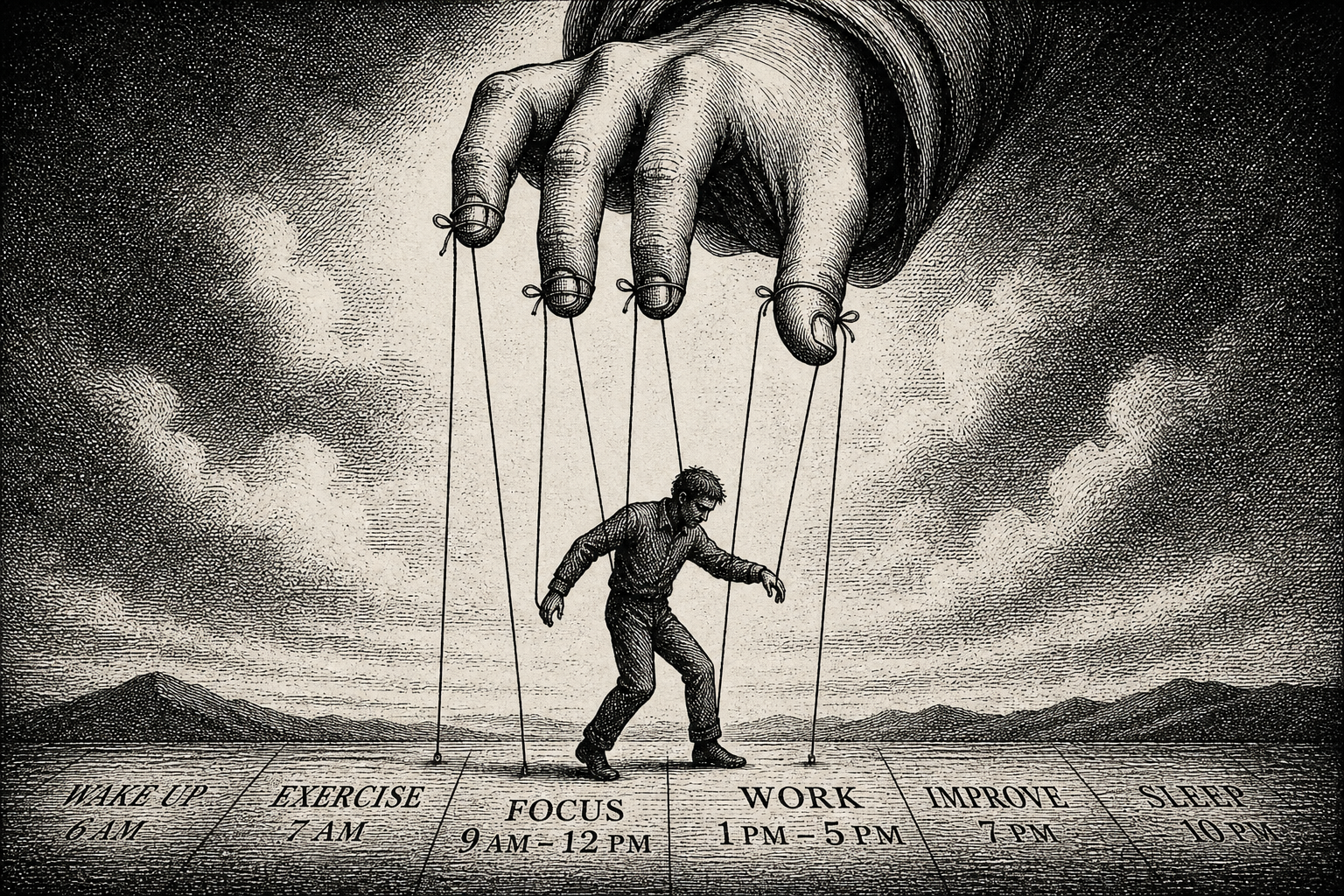
The machine I run every morning (before coffee, before doubt)
Inputs → lag → output. No inspiration required.
If you wake up asking what to post, you don't have a content problem — you don't have a machine.
Operators ask what the system needs today. Posts, replies, DMs — check boxes, trust lag. I spent a year thinking in posts before I built something that runs without inspiration.
The algorithm isn't your manager. The calendar is.
Inputs → lag → output
→ Scheduled inputs daily → skill and voice compound in private
→ Lag hides progress for weeks → quitters reset before bend
→ Operators trust lag → creators panic-pivot weekly
→ Sunday review → one adjustment → machine improves without drama
→ Machine on bad days → identity as operator → 5.3K 𝕏, 16.2K LinkedIn as lagging proof
Lag is where quitters quit
I don't wake up creative. I wake up on a schedule. The machine runs whether I feel like it or not.
Operators think in systems. Creators think in posts. I spent a year thinking in posts before I built a machine that could run without inspiration.
This letter is the map I use every week — inputs, lag, output, feedback.
6:30–7:15 — Write
Three posts. Not three perfect posts. One story, one lesson, one proof line. Batch when I can. Timer: 45 minutes. Phone in another room.
2:00–2:45 — Reply
Fifty replies on focus days. Thirty minimum otherwise. Not "great post!" — questions, additions, short stories. Replies are mini-posts in someone else's room.
7:30–8:00 — DM
Five messages to people I genuinely want to know. Not pitches. Not "collab?" — specific, human, short.
Sunday — 20 minutes
Winners folder. Flops folder. One adjustment for next week. Follower check happens here — nowhere else.
The algorithm isn't my manager. The calendar is.
5.3K on 𝕏 and 16.2K on LinkedIn are lagging indicators of this loop — not of one brilliant thread.
- Write window — same time, same duration
- Reply window — separate from writing
- DM cap — small enough to be human
- Review — weekly, timed, boring
Month 1: $0. Month 2: $0. Month 3: $223. Month 13: $7,502. Imagine if I had quit.
Lag is where quitters quit
I posted for 60 days with almost nothing to show. The inputs were correct. The lag was lying to me.
Operators trust the lag. Creators panic and change strategy every week — new niche, new format, new platform. They reset the lag clock every time.
Metrics that matter
Daily: posts shipped, replies sent, DMs sent. Weekly: profile visits, new followers, saves. Monthly: revenue, newsletter subs, inbound opportunities.
Never daily: follower count obsession. That's output staring — it makes you emotional about lag.
5.3K on 𝕏. 16.2K on LinkedIn. 1,100+ subs. All lagging indicators of years of input focus.
Growth operators don't ask "what should I post?" They ask "what does the system need today?" Posts, replies, DMs — check the boxes, trust the machine.
The map works on any platform. Inputs on 𝕏 look like volume. Inputs on LinkedIn look like depth. The structure is identical.
Become the person who measures what they control. The graph becomes a lagging reward, not a daily mood swing.
Draw the map tonight. Run it for 30 days. Then tell me inputs don't matter.
The machine runs on bad days too — that's the whole point. Inspiration is a bonus. The calendar is the contract.
Operators vs creators
I spent a year thinking in posts before I built a machine that could run without inspiration. Creators ask "what should I post?" Operators ask "what does the system need today?" Posts, replies, DMs — check the boxes, trust the machine.
The machine isn't complicated. It's just scheduled. 6:30–7:15 write. 2:00–2:45 reply. 7:30–8:00 DM. Sunday twenty minutes review. Same windows. Same numbers. Phone in another room during writing. Reply list pre-loaded.
Lag is where quitters quit
I posted for sixty days with almost nothing to show. The inputs were correct. The lag was lying to me. Operators trust the lag. Creators panic and change strategy every week — new niche, new format, new platform. They reset the lag clock every time.
Daily metrics that matter: posts shipped, replies sent, DMs sent. Weekly: profile visits, new followers, saves. Monthly: revenue, newsletter subs, inbound opportunities. Never daily: follower count obsession. That's output staring — it makes you emotional about lag.
The same machine, different surfaces
5.3K on 𝕏 and 16.2K on LinkedIn are lagging indicators of this loop — not of one brilliant thread. LinkedIn runs on a lighter version — three posts per week, same review, same proof standard. Different surface, same operator.
Inspiration is optional. The calendar isn't. Build the machine small enough that you can run it on your worst day — then scale the numbers, not the complexity. The algorithm isn't my manager. The calendar is.
Inputs → lag → output → feedback
Growth operators don't negotiate with mornings. Three posts — not three perfect posts. One story, one lesson, one proof line. Fifty replies on focus days — not "great post!" Questions, additions, short stories. Replies are mini-posts in someone else's room.
Five DMs to people I genuinely want to know. Not pitches. Not "collab?" — specific, human, short. Sunday: winners folder, flops folder, one adjustment. Follower check happens here — nowhere else.
Become the person who measures what they control. The graph becomes a lagging reward, not a daily mood swing. Draw the map tonight. Run it for thirty days. The machine runs on bad days too — that's the whole point.
The worst Tuesday
I remember one Tuesday: slept badly, client call ran long, wanted to skip replies. The machine said: open the tab at 2pm. I did 22 replies in twenty minutes — minimum viable human. Not heroic. Consistent. That week still bent slightly upward. The machine doesn't need your best day. It needs your scheduled day.
That's the difference between inspiration-dependent creators and operators. Operators have floors. Creators have peaks. Peaks don't compound. Floors do.
Scaling without breaking the machine
When I added LinkedIn, I didn't duplicate the 𝕏 machine — I compressed it. Three posts per week instead of twenty-one. Same proof standard. Same Sunday review. Same ban on daily follower checks. 16.2K didn't require a new personality. It required respecting a different room.
Don't scale complexity. Scale numbers on a machine you can run sick, tired, and doubtful. If your system requires peak motivation, it's not a system — it's a wish.
Feedback loops
Sunday review isn't nostalgia. It's engineering. Winners folder: what got saves, DMs, replies? Flops folder: what sounded like everyone else? One adjustment — not five. Maybe shorter hooks. Maybe more numbers. Maybe different rooms. Run it seven days. Review again.
The calendar doesn't care about your narrative
There's a version of this work that sounds romantic — flow states, muse, inspiration. I don't live there. I live in 45-minute timers and pre-loaded reply lists. Romance is what you tell people at 5.3K. Accounting is how you get there.
Month 13: $7,502 wasn't a feeling. It was lag. The calendar didn't care about my narrative on bad Tuesdays. It cared whether I opened the tab.
Build a machine you can defend on your worst day. Then run it until the graph catches up.
Start with one window tomorrow — write, reply, or DM. Don't add all three on day one. Stack after seven days of honesty.
LinkedIn runs on a lighter version of the same machine — 3 posts per week, same review, same proof standard. 16.2K there didn't come from a different personality. Different surface, same operator.
Inspiration is optional. The calendar isn't. Build the machine small enough that you can run it on your worst day — then scale the numbers, not the complexity.
- You're starting to notice inspiration is unreliable
- You're starting to notice good weeks followed by zero weeks
- You're starting to notice you're negotiating with yourself every morning
- You're starting to notice operators treat growth like accounting
- You want a system but you keep buying tools instead of time blocks
The morning machine
6:30–7:15 write: three posts, timer 45 minutes, phone elsewhere. 2:00–2:45 reply: fifty on focus days, thirty minimum. 7:30–8:00 DM: five humans, not pitches. Sunday twenty minutes: winners, flops, one adjustment.
One Tuesday I did 22 replies in twenty minutes — minimum viable human. Not heroic. Consistent. That week still bent slightly upward. The machine doesn't need your best day.
But Andrei — I don't have three hours a day. Start with one window. One. Write OR reply OR DM — pick the bottleneck under 2K it's probably replies. Stack after seven honest days. Complexity is procrastination wearing a planner.
How to engineer a growth machine
Worst Tuesday: client call ran long, wanted to skip replies. Machine said open tab at 2pm. Twenty-two replies in twenty minutes — minimum viable human. Week still bent slightly. Operators have floors. Creators have peaks. Peaks don't compound.
Don't scale complexity. Scale numbers on a machine you can run sick, tired, doubtful. If your system requires peak motivation, it's a wish — not a system.
How to engineer a growth machine
Map what you actually did last week — not what you planned. That's your real system today.
Draw inputs → lag → output on paper. Circle what you control. Stop staring at what you don't.
Same time, same duration, same tab order. Pre-load reply lists. DM templates are fine if the message is human.
Run 30 days. Scale numbers, not complexity. LinkedIn got a lighter version — three posts per week, same review. Different surface, same operator.
Thank you for reading.
– Andrei
When You're Ready, Here's How I Can Help You:
The 0→1K Daily System
Hit 1,000 followers on 𝕏 in 90 days — daily checklist, copy-paste templates, and engagement scripts in folders you open every morning.
€147 €47
Get Instant Access →